
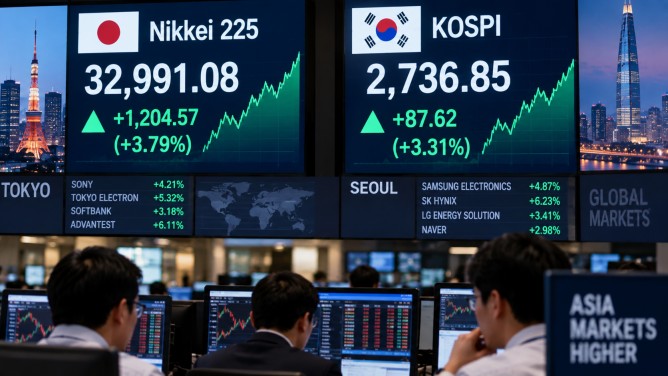
Monday saw a varied performance across global stock markets, with Asian exchanges leading the way due to significant buying in technology and semiconductor sectors. Japan’s Nikkei 225 rose by 2.1% and South Korea’s Kospi surged 4.6%, driven by notable gains in semiconductor giants like Samsung Electronics and SK Hynix, which climbed 5.7% and 8.1% respectively. Other companies in the chip sector, such as Renesas Electronics, Rohm, and Tokyo Electron, also experienced robust upticks. This upward trend underscores the sustained investor enthusiasm for artificial intelligence and semiconductor companies, with AI-related hardware continuing to act as a core catalyst for Asian equity markets.
In contrast, European markets exhibited more restrained activity. France’s CAC 40 showed little movement, while both Germany’s DAX and Britain’s FTSE 100 saw slight declines. Across the Atlantic, U.S. stock futures suggested a softer start to trading, although the U.S. markets were closed due to the Labor Day holiday.
Elsewhere in Asia, Hong Kong’s Hang Seng index fell 0.9%, while the Shanghai Composite Index remained nearly static. Australia’s S&P/ASX 200 managed a modest increase, reflecting a mixed day for the region as a whole.
The foreign exchange markets also drew attention, particularly with the U.S. dollar’s dip against the Japanese yen. The yen’s recent depreciation has caused concern among Japanese officials, prompting close monitoring for any indications from the Bank of Japan regarding future interest-rate decisions.
Meanwhile, oil prices stayed high amid ongoing tensions between the United States and Iran, exacerbating worries about inflation and the larger global economic landscape. Investors are on the lookout for upcoming U.S. inflation figures and the Federal Reserve’s policy meeting in September, which are expected to provide further insights into the trajectory of interest rates.